




















 Loading...

In the vibrant, gravity-defying universe of online arcade gaming, where most titles challenge you to climb ever higher, jump ever further, and ascend into the sky, a brilliantly counter-intuitive experience dares to flip the script. This is the world of the downward scroller, a genre that takes the familiar thrill of the endless runner and platformer and inverts it, sending you plummeting into the depths rather than soaring into the heavens. Among the most polished, addictive, and refreshingly unique entries in this downward-spiraling category is Ball Down, a game hosted on the GamePix platform that transforms the simple act of falling into a tense, strategic, and utterly captivating arcade challenge.
The premise of Ball Down is a stroke of inverted genius. You control a ball—a bright, responsive, and delightfully weighty sphere—and your mission is not to go up, but to go down. The screen scrolls vertically, but it scrolls downwards, into the depths of a colorful, abstract chasm. The path is not a solid surface; it is a treacherous, ever-changing gauntlet of platforms, obstacles, and hazards that you must navigate as you descend. Platforms are spaced with gaps that you must fall through. Obstacles like spinning blades, crushing barriers, and deadly red zones threaten to destroy your ball on contact. The ever-present danger is not just falling into a bottomless pit, but being crushed against the top of the screen if you descend too slowly, or smashing into a hazard if you fall too fast without control. It is a game of speed management, spatial precision, and the delicate, thrilling balance between a controlled fall and a chaotic, out-of-control plummet.
This comprehensive guide is your survival manual for the beautifully inverted world of Ball Down. Whether you are a newcomer watching your ball get crushed at the top of the screen, a casual player struggling to thread the needle through fast-moving gaps, or a descending perfectionist aiming for a record-shattering depth score, this article will provide the strategies, control techniques, and mental frameworks you need. We will deconstruct the unique physics of the controlled descent, reveal the secrets of speed management and gap prediction, teach you how to read the scrolling terrain, and cultivate the calm, focused, anticipatory mindset required to fall with grace, precision, and survival. Prepare to look down, embrace gravity, and let the ball fall. The depths are calling, and the only way out is down.
Into the Depths: What is Ball Down?
Before we start plunging through gaps and dodging spinning hazards, it is essential to appreciate the clever, inverted design and the addictive appeal of Ball Down. This is a browser-based downward-scrolling arcade platformer that stands out by doing the opposite of what most games in its genre attempt. The core loop is a constant, tense negotiation with gravity: fall, steer, survive, and descend deeper into the unknown.
The Aesthetic of the Abyss
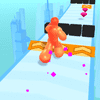
The visual design of Ball Down is a vibrant, colorful descent into an abstract, geometric underworld. The background is likely a dynamic, shifting gradient that changes hue as you descend deeper, creating a palpable sense of progression and depth. You might start in a bright, sky-blue zone, transition through a fiery orange and red stratum, and eventually plunge into a deep, dark purple or neon-lit cybernetic core. The platforms are rendered in crisp, contrasting colors, making them easily distinguishable from the background and the hazards. Your ball is the luminous focus, a glossy, energetic sphere that might leave a sparkling trail as it falls, its color possibly changing with power-ups or depth milestones. The obstacles are visually distinct and menacing—spinning saw blades, glowing red danger zones, moving crushing blocks—all designed to be instantly readable even at high descent speeds. The sound design is a pulse-pounding mix of driving electronic beats, the rushing wind sound of a fast descent, the sharp "clang" of a near miss, and the stomach-dropping "crunch" of a fatal collision.
The Inversion of Instinct
What makes Ball Down so uniquely challenging and engaging is that it inverts a deeply ingrained gaming instinct. For decades, platformers have trained us that "up" is progress and "down" is danger, that falling is failure. Ball Down rewires this instinct. Here, falling is survival. Descending is progress. The danger comes from above—from being too slow and getting crushed by the scrolling top of the screen. This cognitive inversion is the game's secret weapon. It forces you to unlearn old habits and develop a new, counter-intuitive set of reflexes. The game is not just a test of your thumbs; it is a test of your brain's adaptability.
The Physics of the Plunge: Understanding the Controlled Fall
To master Ball Down, you must become an intimate student of the game's gravity and momentum physics. Your ball is not simply a character moving on a screen; it is a physical object in a constant state of falling, and your control over it is exercised within the laws of acceleration and deceleration.
The Constant Pull of Gravity
Gravity in Ball Down is relentless. Your ball is always being pulled downwards, accelerating if left unchecked. The platforms are your only respite, the surfaces where you can briefly rest and control your lateral position. But resting for too long is fatal, as the top of the screen is constantly scrolling downwards, a relentless ceiling of doom. The fundamental rhythm of the game is a cycle of controlled falls from platform to platform, punctuated by brief, strategic pauses on safe surfaces to line up the next descent.
Speed Management: The Fast and the Slow
The most critical skill in Ball Down is speed management. There are moments when you need to fall fast, plunging through a wide-open vertical corridor to escape the advancing ceiling or to clear a series of moving hazards in a single, rapid drop. And there are moments when you need to fall slow, carefully navigating a tight maze of platforms, threading through narrow gaps, and precisely controlling your lateral drift. The game likely gives you some control over your descent speed. Perhaps pressing down accelerates your fall, while releasing or pressing up slows it, or maybe you have a limited-use air brake. Mastering the modulation between fast and slow descent, knowing when to commit to a full-speed plunge and when to feather the controls for a gentle, precise drop, is the core of expert play.
Lateral Drift and Mid-Air Steering
As you fall, you also have lateral control, steering the ball left and right. However, in a fast descent, your lateral control is less responsive than on a solid platform. There is a drift, a sense of momentum that carries you. You must learn to anticipate this drift, initiating your lateral movements early to line up with a distant gap. A common beginner mistake is to wait until they are directly above a gap and then try to steer into it, only to miss because the ball's momentum carried them past. The expert player reads the terrain below, identifies the target gap, and begins the lateral adjustment well in advance during the fall.
The Art of the Descent: Reading the Terrain and Planning Your Route
Your descent is not a random tumble; it is a planned route through a procedurally generated or carefully designed vertical landscape. Reading that landscape and planning your path in real-time is the strategic heart of the game.
The "Look Down" Principle
Your eyes must not be fixed on your ball. Your ball is where you are, which is information you already have. Your focus must be trained downwards, scanning the upcoming terrain. You need to see the next platforms, the next gaps, the next hazards, several "moves" ahead. By looking down, you give your brain the crucial time it needs to process the layout, plan a safe route, and send the correct commands to your fingers before the ball reaches the danger zone. Players who stare at their ball are constantly reacting late. Players who look ahead are proactively navigating.
The Gap Analysis
The platforms are arranged with gaps between them, and these gaps are the passages through which you must fall. Not all gaps are created equal. A wide gap is an invitation to descend quickly. A narrow gap requires a slow, precise approach and perfect lateral alignment. A gap that is positioned above a hazard or a dead-end platform is a trap. A gap that is aligned with a series of further gaps below is a "lane," a safe vertical corridor that allows for a sustained, high-speed drop. Learn to instantly analyze the gaps. Identify the safe lanes and the trap gaps. Your route is a sequence of gap choices.
The Obstacle Dance
As you descend, obstacles will be placed within the vertical corridors. A spinning blade guarding a narrow gap. A moving wall that opens and closes a passage. A red zone that must be skirted around. Each obstacle has a rhythm and a safe window. Observe the obstacle for a brief moment before committing to the descent through it. Time your fall so that you pass through the gap precisely when the blade is rotated away, or when the wall is open. Rushing blindly into an obstacle is the most common cause of death.
The Perils of the Plunge: Hazards and Strategic Responses
The depths of Ball Down are filled with specific hazards designed to punish different types of mistakes.
The Ceiling of Doom
The top of the screen is a scrolling, instant-kill barrier. If you linger too long on a platform or descend too slowly, the ceiling will catch you and crush you. The ceiling is the game's primary enforcer of pace. It prevents you from playing too cautiously and forces you to commit to the descent. Always be aware of the ceiling's position. The screen likely provides a visual warning when it is getting close.
The Dead-End Platform
A platform with no gap below it, or a platform positioned directly above a solid wall. Landing on a dead-end platform is a death sentence, as you will have no way to descend further before the ceiling crushes you. You must identify dead-end platforms from above and actively steer away from them during your fall, aiming for a different platform with a viable gap.
The Moving Obstacle
Spinning blades, rotating bars, sliding crushers. Each moves with a predictable pattern. The strategy is patience and timing. Hover on a safe platform above the obstacle if possible, study its cycle, and make your move during the safe window.
The Red Zone
A static or moving area that destroys your ball on contact. Red zones are often placed to block the most direct or obvious descent paths, forcing you to take a more circuitous, skillful route around them. They test your lateral steering during a fall.
The Inner Descent: The Psychology of the Downward Spiral
The mental challenge of Ball Down is unique and demanding. The inverted gravity, the relentless pressure from above, and the need for constant, rapid decision-making create a specific psychological landscape.
The Calm in the Fall
Panic is the enemy of a controlled descent. When the ceiling is closing in and the path below looks like a chaotic maze of platforms and hazards, the natural instinct is to tense up and make frantic, jerky movements. This leads to mistakes. The expert player cultivates a state of calm, focused alertness. The descent is fast, but the mind is still. Breathe steadily. Keep your hands relaxed. Trust your ability to read the terrain and make the right split-second decisions.
The Commitment to the Plunge
Hesitation is fatal in Ball Down. Once you have identified your route and decided to drop, you must commit to the descent. A mid-fall second-guess that causes you to try to reverse direction or land on an unintended platform often results in a missed gap and a crushed ball. Make your decision, trust your plan, and execute the fall with full commitment.
The Depth Mindset
The score in Ball Down is measured in depth—how far you have descended. The deeper you go, the faster the scroll, the more complex the terrain, and the more intense the pressure. Focus on the process of each individual descent, not on the accumulating depth number. The depth is a measurement of your past successes. The next gap is the only reality that matters. This present-moment focus is the mindset of the deep diver.
Conclusion: The Bottom is Just the Beginning
As the ball finally succumbs to the relentless gauntlet and the screen displays your record-breaking depth, we arrive at the conclusion of our guide to Ball Down. The game, in its brilliant inversion of platforming convention, has tested your adaptability, your speed management, and your ability to stay calm under the unique pressure of a world where falling is survival.
We have deconstructed the physics of the controlled plunge, learning to modulate between fast and slow descent and to master the lateral drift of mid-air steering. We have learned to read the downward-scrolling terrain, training our eyes to look ahead, analyze gaps, and plan safe vertical lanes. We have prepared for the perils of the depths, from the crushing ceiling to the dead-end traps and the rhythmic obstacles. And we have cultivated the inner calm, the commitment to the plunge, and the present-moment focus that defines the master of the downward spiral.
The Ball Down game on GamePix is a refreshing, thrilling, and brilliantly designed challenge that proves the way down can be just as exciting, if not more so, than the way up. The chasm is open. The ball is at the top. The depths are calling. Take a deep breath, look down, and let the ball fall. Happy descending.
Embed this game